Why a Label Can Make a Record Easier to Use
A clear label makes a record easier to find and interpret by connecting its contents to the questions a future reader is likely to ask.
You may remember that a record exists but not what it was called, where it was filed or which detail will help you find it. A useful label gives that future searcher a few plain-language clues: what the record concerns, who or what it relates to, and why it might matter.
Think of a label as a small signpost, not a miniature account of everything inside. Its job is to connect the record to likely questions without making the reader guess at private shorthand or decode an elaborate naming system.
Start with the reader’s question
A record’s creator may describe it by its format: “notes”, “scan” or “meeting file”. Someone searching later may instead ask, “Which meeting?”, “Notes about what?” or “Where is the signed copy?” A label works best when it answers the question a person is likely to type or ask aloud.
Before naming an item, imagine the reader has no memory of making it. Write down the clue they would need first: a subject, a person, a place, a project or a type of event. Choose only details that genuinely help distinguish this record from others.
Say you have saved notes from a neighbourhood tree meeting. “Notes” gives little to search for; “Tree meeting notes — North Lane planting” gives a topic and place in familiar words. A later reader looking for planting decisions can recognise the file without opening several unrelated documents.
Choose terms people use
Plain language is not the same as vague language. “Repairs” may be too broad if the record concerns the library roof, while an internal code such as “BLD-7” may make sense only to the person who created it. Prefer the clearest everyday term that distinguishes the subject.
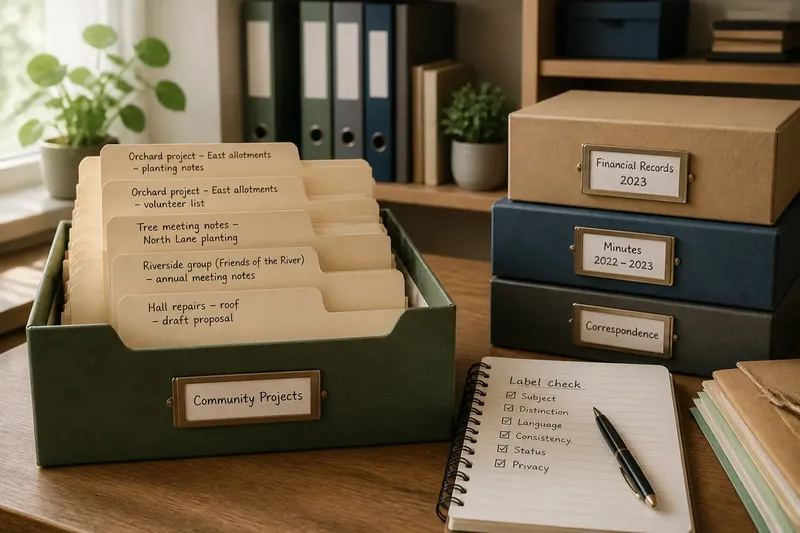
Consider what words a future reader might use: a person’s familiar name, the name of a local group, a place as people commonly call it, or the subject stated directly. If an official title differs from everyday speech, use both where space allows, such as “Riverside group (Friends of the River)”.
Be careful with abbreviations. If a small team uses “AGM” consistently, it may be a useful search term; if new readers may not know it, spell out “annual meeting” or include both. A label should invite recognition, not require a private glossary.
Keep naming consistent
Consistency lets readers predict where a detail will appear. If one set of records begins with the place and another begins with the subject, searches and visual scanning become harder. Agree a simple order and use it across related material.
A modest pattern might be “subject — place or group — record type”. For example, “Orchard project — East allotments — planting notes” and “Orchard project — East allotments — volunteer list” share the same opening terms, while the final words distinguish their contents.
Do not force every item into a rigid template. A private letter, a map and a set of minutes may need different clues. Keep the elements that help retrieval, and leave out fields that add ceremony without helping anyone find or identify the record.
Make labels searchable
People often search with incomplete clues. They may remember “the hall”, not its formal name, or “the spring clean”, not the project title. Where those alternatives are genuinely useful, include a familiar term alongside the more precise one.
Use words that can be typed or recognised reliably. Decorative punctuation, unexplained initials and inconsistent spellings can split related records into separate search results. A hyphen or comma is fine if it improves reading; the important point is to use the same choice in similar labels.
For digital files, put the descriptive words in the filename or the system’s title field rather than relying only on a note buried inside the document. For paper folders, write the label where a person will actually look: on the folder tab, box end or register entry. The label should travel with the record through its ordinary handling.
Separate identity from interpretation
A good label identifies the material without claiming more than the record supports. “Draft proposal” is safer and more useful than “Approved plan” if approval is unclear. “Letter from Sam Patel” may identify the sender; “Sam Patel’s complaint” adds an interpretation that may not be needed for retrieval.
Where a record’s status matters, name it plainly: “draft”, “signed copy”, “transcription” or “working notes”. If the label cannot settle a question, let the record itself or an accompanying note do that work. Avoid squeezing uncertain conclusions into the title.
For sensitive material, consider whether a label exposes personal details to people who can see the folder or file list. Use enough information for authorised readers to identify the item, without putting confidential content on display. Follow the relevant organisation’s handling rules where they apply.
Check a label before filing
Read the label as someone unfamiliar with the item would. Can they tell what it concerns? Could they distinguish it from neighbouring records? Are the words likely to match the terms they would search for?
- Subject: Does the label name the topic rather than only the format?
- Distinction: Does it separate this item from similar records?
- Language: Are its main terms familiar to the people who will use it?
- Consistency: Does it follow the naming pattern used for related items?
- Status: Does it identify a draft, copy or final version where that matters?
- Privacy: Does it reveal more about a person or sensitive subject than necessary?
If a label fails one of these checks, change the wording before filing or update the catalogue entry. Keep the original title inside the record if it is meaningful, but do not let a creator’s shorthand be the only route to it.
Questions about record labels?
How long should a record label be?
Make it long enough to distinguish the record and short enough to scan. A few specific clues usually serve a reader better than a sentence that repeats the document’s contents.
Should a label include a date?
Include a date when it separates related records or helps answer a likely search, such as which meeting produced the notes. Use the date style already used in the collection so readers can compare items consistently.
Should the label match the original title?
Keep an original title if it carries useful meaning, but add a clearer descriptive title when the original is vague, abbreviated or missing. A catalogue can preserve both, making the item recognisable under either wording.
What if the subject is uncertain?
Describe what is observable, such as “handwritten notes mentioning the allotment”, rather than guessing at purpose or authorship. A brief note can record what remains unclear for the next person.
Leave a usable trail
A label is a small record about a larger record: it tells a future reader where to begin. Use the phrase they are likely to search, keep related labels consistent, and mark uncertainty rather than disguising it.
When you create or file something today, pause before saving and ask what a stranger would call it. That short act of translation can make the record easier to recognise, retrieve and pass on when its original context has faded.