The Archive Is Not the Same as a Pile of Old Papers
An archive becomes useful when selection, arrangement and description work together, helping readers find the records that matter and understand their context.
How do you turn a box of papers into an archive someone else can use? An archive is not the same as a pile of old papers: keeping material is only the first task, alongside deciding what belongs, arranging it and describing it clearly.
These jobs are distinct. Selection shapes what survives; arrangement shows how records relate to one another; description helps someone discover and interpret them. A week of modest, deliberate work can establish all three without pretending that every item needs elaborate treatment.
Start with the purpose
Before sorting, write a short statement of what the collection is meant to preserve. It might document a community garden’s decisions, the work of a small theatre group, or the changing use of a shared building. A useful purpose is specific enough to guide choices but broad enough to include material that gives context.
Then name the people who may use the collection and what they might need to learn. Someone tracing decisions will need minutes and correspondence; someone following a project’s development may also need drafts, plans and photographs. This is not a promise to keep everything. It is a way to judge whether a record contributes to the story the collection is meant to support.
Set aside a clean, dry work area and gather basic supplies: folders, removable paper slips, a pencil, a notebook and a simple spreadsheet if one is available. Do not write on original documents or use adhesive labels on them. If material is fragile, damp, mouldy or potentially hazardous, stop handling it and ask an archivist or conservator for appropriate advice.
Monday: survey the material
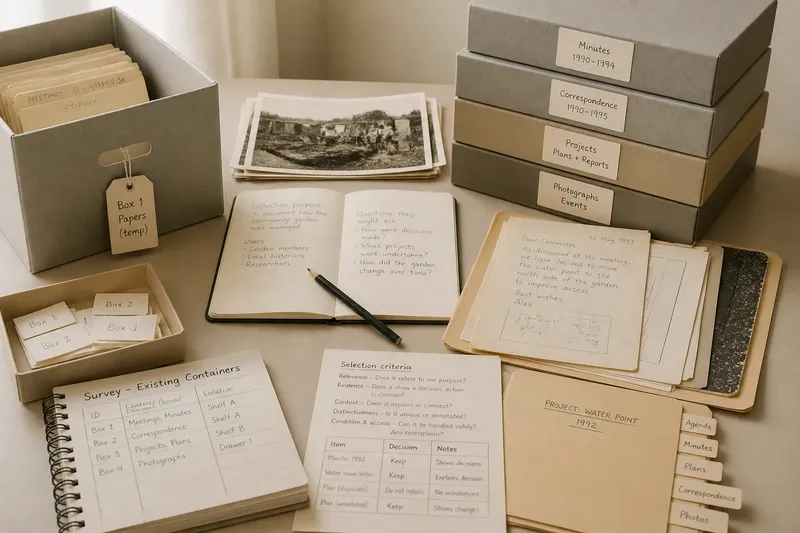
Begin by noting what exists before changing its order. Record the containers, broad contents and any visible groupings: for example, a box of meeting papers, a set of event photographs or a folder of correspondence. Give each container a temporary identifier on a separate slip, and note its current location.
Look for clues to how the material came together. A bundle tied with string, papers kept in a named folder, or documents grouped by a former officer may preserve useful relationships. Avoid taking everything apart just because the current arrangement looks untidy. Photographing the overall layout can help you remember what was where, provided the images are stored and identified responsibly.
During this survey, distinguish original records from later copies where you can do so without guesswork. A printed duplicate may still be useful, but it does not necessarily replace a signed original or a draft with meaningful annotations. If you cannot tell which is which, record the uncertainty rather than silently choosing.
Tuesday: decide what belongs
Selection is not a contest to keep the oldest or most attractive item. Ask whether a record supports the collection’s purpose, adds evidence or context, or preserves a relationship that would otherwise be lost. A routine duplicate may add little; a marked-up duplicate can reveal a decision or revision and may deserve attention.
Use consistent, written criteria. For each group, consider:
- Relevance: Does it relate to the people, activity or subject named in the collection purpose?
- Evidence: Does it show a decision, action, exchange or outcome?
- Context: Does it explain another record or preserve a connection between records?
- Distinctiveness: Is it a unique original, an annotated copy or otherwise different from the rest?
- Condition and access: Can it be handled safely, and are there privacy, copyright or other restrictions to consider?
Make a short note when a decision is difficult. Keep, review and do-not-retain can be practical working categories, but do not discard material simply because it appears redundant. If a record contains personal information or ownership is unclear, pause and seek suitable professional advice before making it available or removing it.
Say a neighbourhood allotment group has one box containing minutes, repeated copies of a planting plan and a letter explaining why a shared water point was moved. Its written purpose is to document how the garden was managed. The minutes and explanatory letter fit directly; the plain duplicate plans may not add much, while a copy bearing a handwritten change could explain the decision. The expected result is a smaller, more coherent body of records, with the reasoning for each uncertain choice preserved in a note.
Wednesday: retain relationships
Arrangement gives records a structure. It should help a reader see how the material was created and used, not impose a tidy pattern that erases its history. Where an organisation’s original groups remain understandable, keep them together. A set of correspondence arranged by project, for instance, may be more informative than separating every letter by sender.
When no useful order survives, choose a simple arrangement suited to the material: by activity, project, date or record type. Use one principle at a time where possible, and explain any exception. You might place each committee meeting’s agenda, minutes and supporting papers together, while keeping photographs in a separate series that points back to the relevant project.
Keep the arrangement at a level you can maintain. A small collection may need only a few series and folders; creating a deep hierarchy for every loose sheet can make the structure harder to understand. Avoid rearranging individual documents unless there is a clear reason. Their order within a file may itself reveal how people worked.
Thursday: describe what remains
Description gives a reader a route into the collection. Start with a brief overview: who created the records, what activities they document, the broad dates or periods represented, how the material is arranged, and any known access limits. Mark gaps and uncertainty plainly rather than filling them with assumptions.
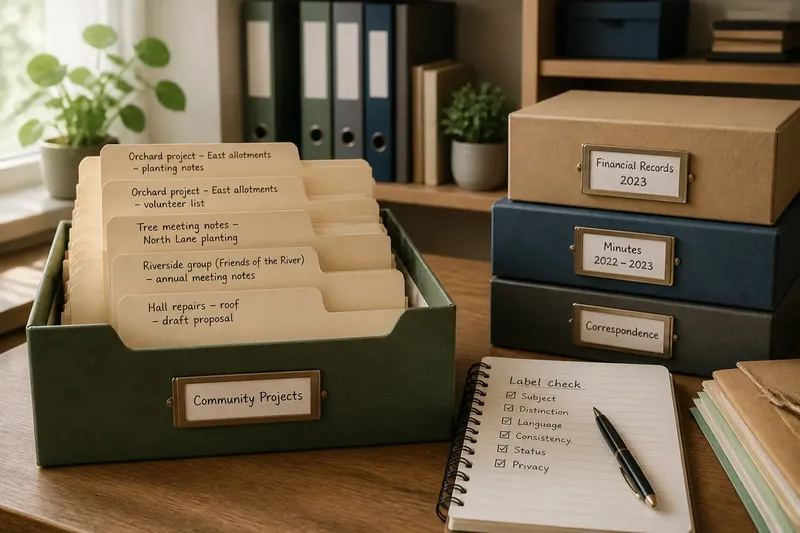
Then make a folder list with enough detail to guide a search. “Committee papers” is less useful than “Committee meeting minutes and agendas, organised by meeting”; “Photographs” may need a note about the events or people shown if that information is known. Do not identify a person or event from appearance alone when you lack reliable evidence.
A spreadsheet can hold a small catalogue. Useful columns include identifier, title or description, dates if known, series or folder, extent in plain language, access notes and location. Keep identifiers stable: if a folder moves, update its location rather than changing its identity. Store a copy of the catalogue separately from the records it describes.
Friday: check the reader’s route
Try using the description as if you had never seen the collection. Can you tell what it covers, where a relevant folder is, and whether a restriction applies? If a term is meaningful only to the original group, explain it in plain language. If a description claims more than the item supports, narrow the wording.
Imagine a new volunteer looking for decisions about the allotment’s water point. The catalogue points to the meeting papers and the related correspondence, while the overview explains that the group’s records are organised by activity. The expected observable result is that the volunteer can identify a likely folder and understand why it belongs, without relying on the person who sorted it.
Check that every folder identifier appears in the catalogue and that each catalogue entry corresponds to material you can locate. Note what remains unresolved: an unclear date, an unidentified photograph or a gap in a run of minutes. These notes are useful description, not a failure to finish.
What should an archive explain?
Does every item need its own description?
No. Describe at the level that helps people find and understand the material. A folder-level entry may be enough for routine papers, while a particularly significant or difficult-to-identify item may need its own note.
Should records be arranged by date?
Only when dates make the material easier to use and do not break meaningful groups apart. Keep related records together when their connection explains how a decision or activity unfolded.
What if the original order is unclear?
Choose a consistent arrangement that suits the collection, such as project or activity, and record the choice in the overview. Preserve any remaining groupings that appear meaningful, and mark uncertainty instead of inventing a history.
Can a small collection be an archive?
Yes, if it has a defined purpose, considered selection, an intelligible arrangement and enough description for another person to use it. A modest collection with clear context can serve readers better than a larger mass of unorganised material.
Keep the work sustainable
At the end of the week, review the purpose statement, selection notes, arrangement and catalogue together. Ask someone unfamiliar with the collection to find one type of record using only the overview and folder list. If they cannot, improve the description or structure before adding more detail to every item.
After this first pass, set a simple routine for new material: note who supplied it and why, keep it with the activity or project it belongs to, and add it to the catalogue before putting it away. Check the collection periodically for changes in access needs, new context or records that clarify earlier uncertainty. The archive is useful not because every paper has been saved, but because a reader can see what was selected, how the records relate and where to begin.