A Family Recipe Card the Next Cook Can Follow
A family recipe card that records quantities, sensory cues and decision points helps another cook make the dish confidently, even without your guidance.
You have written “cook until ready” on a family recipe card, and the next cook is staring at a pan, unsure what ready looks like. A family recipe card that pairs quantities with sensory cues can carry the method as well as the ingredients, so another person can make informed choices without asking you to stand beside the hob.
Try the exercise around a seasonal meal you already cook: choose one dish, make it as usual, and keep a pencil and blank card nearby. The aim is not to turn a family recipe into a laboratory protocol. It is to notice where someone new would hesitate, record what you can observe, and make those decisions easier to repeat.
Choose one dish
Start with a recipe that belongs to a familiar part of the year: a winter soup, a summer fruit crumble or a spring herb sauce. Pick a dish you make often enough to recognise its turning points, but not one so effortless that you forget what a beginner needs to know.
Before you cook, write down what you already know. Add the dish’s name, the amount it makes in ordinary serving terms, and any equipment that affects the result, such as a wide frying pan or a deep saucepan. A phrase like “feeds the family” may mean different things to different households; record a useful serving description instead.
Then set out a blank card or a sheet of paper. Do not interrupt the cooking to write every movement. Watch for the moments when you alter the heat, wait for a change in smell, or decide that an ingredient has cooked enough. Those are often the details that disappear from memory because they feel obvious to the person who makes the dish.
Find the missing cues
Many recipe cards list ingredients but leave the method in shorthand. “Add the onions, then simmer” does not tell a new cook whether the onions should soften without colour, turn golden, or become deeply browned before the liquid goes in.
For each important action, add the cue you use to judge it. Useful cues may involve:
- Appearance: onions are soft and translucent; fruit has collapsed at the edges; a batter has no visible dry flour.
- Sound: a gentle sizzle continues, or bubbling settles to an occasional blip.
- Smell: toasted spice becomes fragrant, or raw flour gives way to a warm, baked aroma.
- Texture: a spoon passes through a thick mixture and leaves a brief trail, or a piece of root vegetable yields to a fork.
- Taste: a sauce may need salt, acidity or sweetness adjusted before serving.
Choose cues that actually guide your decisions. “Smells delicious” is pleasant but vague; “the sharp raw-garlic smell has softened” gives the next cook a change to look for. When a cue is hard to describe, ask yourself what you notice just before you move to the next step.
Write a quantity where it matters, but do not let numbers crowd out judgement. If your family adjusts lemon juice to taste, record a starting amount and the flavour you are aiming for, such as “bright, not sharply sour”. If the amount varies with the fruit or the dish, say so rather than pretending the same measure always fits.
Fix unclear instructions
When a recipe feels difficult to follow, find the first point where a cook would have to guess. Do not rewrite the whole card at once; a single unclear transition can make the rest of the method seem unreliable.
What does “cook until soft” mean?
Replace “soft” with a cue tied to the ingredient and the next action. For diced carrot, you might describe a piece yielding when pressed with the back of a spoon while still holding its shape; the exact cue should match how you want the finished dish to feel.
How should I describe heat?
Use the hob setting as a starting point only if it is meaningful on your cooker, then add what the pan should do. “Medium heat, with a steady gentle sizzle and no smoking” is more helpful than “medium” alone, because cookers and pans vary.
What if the ingredients vary?
Record the range of variation that changes the cooking decision, not every possible difference. For example, note that very juicy tomatoes may need a longer uncovered simmer, and describe the thicker consistency you want before adding the next ingredient.
How do I record a family variation?
Keep the shared method readable, then name the variation and where it belongs. “For Auntie’s version, add chopped mint with the parsley at the end” tells the next cook what changes without making the main recipe ambiguous.
Write the sequence
Once you have spotted the uncertain parts, put the method in the order a cook needs it. Group ingredients by when they enter the pan if that prevents searching, and name the ingredient again in the instruction rather than relying on a vague “add it”.
Keep each instruction focused on one decision or short group of actions. Include a cue before a step that depends on readiness: “Stir in the flour and cook until the mixture smells nutty and no longer looks powdery; then add the stock gradually.” This connects the observable change to the next move.
Include waiting time as an aid, not as the sole test. A note such as “simmer gently until the lentils are tender and the soup thickens; begin checking after a short simmer” acknowledges that ingredients and equipment may differ. Avoid presenting a time as exact if you normally decide by texture.
Say what happens after the heat is turned off. Resting, cooling, draining or finishing with herbs can change the dish, and a card that ends at “remove from heat” may leave the next cook with an incomplete result. Add storage advice only if it is part of the recipe’s use, and follow the food’s packaging guidance and local food-safety advice where relevant.
Make a seasonal card
Let the season help you remember what changes. A summer recipe may depend on ripe fruit releasing more juice; a cold-weather stew may need a slower, gentler simmer to keep pieces intact. Write the cue that tells the cook how to respond, rather than assuming every ingredient behaves alike.
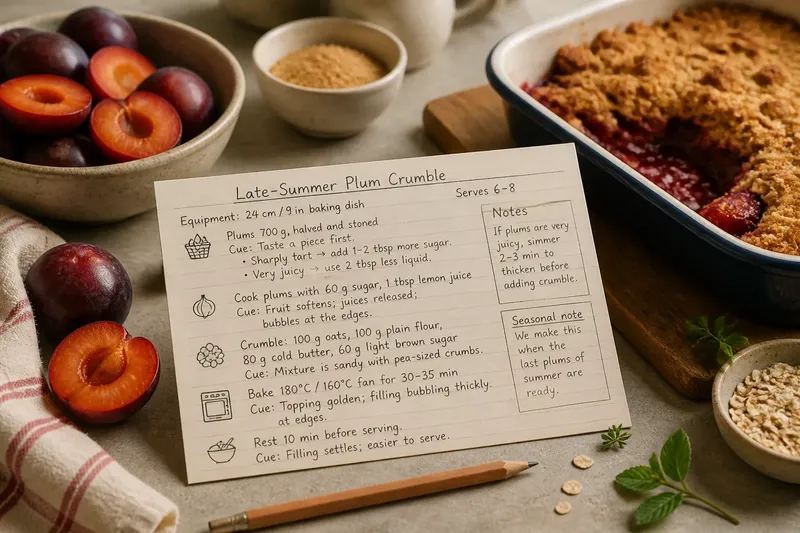
Say you make an imagined late-summer plum crumble and notice that one batch of plums is firm while another is very ripe. On the card, you could record: “Taste a piece first; if the plums are sharply tart, add a little more sugar. If the fruit is very juicy, use the smaller amount of liquid and bake until the filling bubbles at the edges.” The next cook gets a starting point and observable signs, without being told that every plum needs the same treatment.
A seasonal note can also preserve the occasion without taking over the method: “We make this when the first apples are ready” or “Serve warm after the autumn walk”. Keep such context separate from instructions that affect the cooking, so someone can use the recipe at another time of year and still follow it.
Check it with another cook
Before copying the recipe onto a permanent card, ask someone who does not know the method to read it while you stay quiet. Invite them to point to any phrase that leaves them unsure, rather than stepping in to explain. Their questions reveal which details are still living only in your head.
Then revise the card in place or on a fresh copy. Use a clear title, legible handwriting and enough space to distinguish ingredients from instructions; a small index card can become hard to use if every margin is filled. If you want to preserve a family phrase, keep it alongside a practical explanation rather than making the phrase do all the work.
Imagine your cousin reading “add the greens near the end” and asking how near. You might change it to “stir in the chopped greens when the potatoes are tender; cook until the leaves wilt but remain bright.” That edit makes the point of the timing visible and gives the cook a cue for moving on.
Keep the card useful
Leave room for a later note if the recipe changes. A short addition such as “more liquid needed with coarse polenta” can help, but date or identify a revision only when it helps your family distinguish versions. Do not erase a useful variation just because it differs from the way you cook the dish now.
Keep the card where the next cook can find it, away from splashes and heat. A recipe box, a kitchen drawer or a clear sleeve near the family’s other cooking notes can work; choose a place that suits how the household actually cooks. If you make a digital copy, photograph the finished card and store it where relatives can access it, while keeping the handwritten original if its annotations matter.
For a family recipe card to travel well, the most valuable addition is often one sentence beside the ingredient list: what to notice before moving on. Read your card once more and look for an instruction that still depends on your hands, nose or memory. Add the cue that would help the next cook make that decision for themselves.