Flashcards or a Concept Map for Revisiting a Topic?
Flashcards or a concept map can serve different review goals: choose recall for key facts and a map for connections, then match your format to the gap.
You have an hour to revisit a topic, but your notes have grown into a crowded folder: should you make flashcards or a concept map? Flashcards or a concept map work best for different kinds of knowledge. One asks you to retrieve a particular answer; the other helps you see how ideas relate.
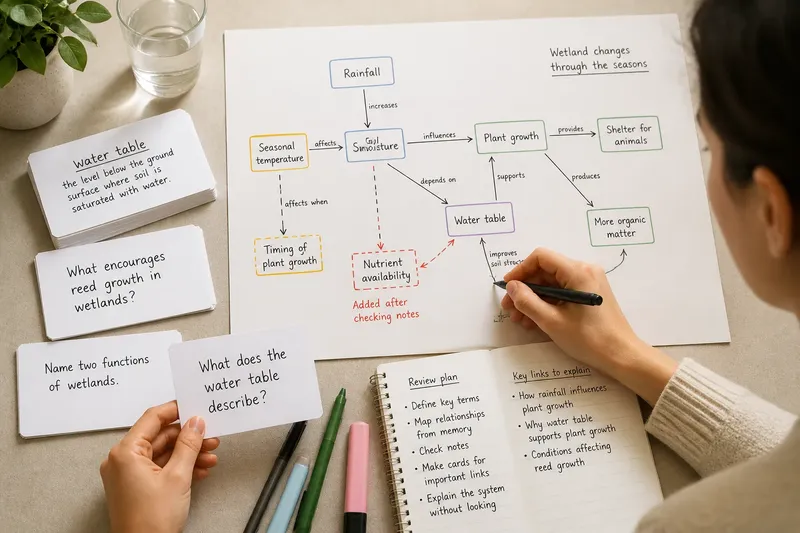
Imagine you are revisiting an invented unit on how a local wetland changes through the seasons. Your notes include terms such as water table and reed bed, plus explanations of how rainfall, plant growth and animal activity affect one another. You want to remember the material well enough to explain it, not merely recognise familiar phrases.
Start with the learning gap
Before choosing a format, name what feels uncertain. Can you recall a term without looking? Can you explain why one change affects another? Can you put the process in order? These are different gaps, and one review tool may not address all of them.
In this invented situation, you can recognise “water table” when it appears in your notes, but cannot define it without peeking. You also know that rainfall matters to the wetland, yet you are unsure how it connects to plant growth. The first gap calls for retrieval; the second calls for a view of relationships.
Write down the intended result in plain language. For example: “I want to define the main terms from memory” is more precise than “I need to revise the wetland topic”. A clear goal makes it easier to tell whether your review is doing useful work.
Use cards for recall
A flashcard separates a prompt from its answer. You look at the prompt, try to retrieve the answer before turning the card, then check whether your response is complete. That pause matters: seeing the answer immediately can feel fluent without asking you to produce it yourself.
Cards suit material with a reasonably clear answer, such as vocabulary, a named process, a distinction, or the next part of a sequence. A prompt might ask, “What does the water table describe?” Another could ask, “Which conditions encourage reed growth in these notes?” The answer should be short enough to check, while retaining the detail needed to avoid confusion.
For the invented wetland review, you make a small set of cards for terms and central claims. On the first pass, you retrieve the definition of “water table” correctly but cannot explain a process named in your notes. That observable result tells you which answer needs repair; it does not, by itself, show whether you understand the wider system.
Keep each card focused on one question. If a prompt asks for a definition, three causes, two exceptions and an example all at once, a partial answer becomes hard to judge. Split it into linked cards, or make one card for the central answer and another for the qualification.
Map the relationships
A concept map gives ideas visible connections. Put a central concept on the page, add related concepts around it, and connect them with labelled lines or arrows. Labels such as “increases”, “depends on” and “changes when” make the relationship explicit rather than leaving the reader to guess what a line means.
Maps suit questions about causes, conditions, contrasts, sequences and feedback. In the wetland example, a map might connect rainfall to soil moisture, soil moisture to plant growth, and plant growth to shelter for animals. A separate connection could show that seasonal temperature affects when particular plants grow. The point is not to make an attractive diagram; it is to state the links you believe the topic contains.
Start from memory, then compare the map with your notes. In the invented situation, you draw rainfall leading to greater soil moisture and connect plant growth to animal shelter. When you check your notes, you notice that your map leaves out a condition affecting plant growth. Add that link in a different colour and write a short note beside it explaining what changed.
A map can still hide uncertainty if it contains many unlabeled lines or copied phrases. Ask whether each arrow can be read as a sentence. If “A affects B” is too vague, specify how or under what condition, or mark the connection as uncertain rather than making it look settled.
Choose by knowledge type
Use the format that matches the response you want to produce:
- Terms and definitions: use a card when you need to retrieve a concise meaning or distinguish similar words.
- Processes and sequences: use cards to recall stages in order, and a map when you need to show what influences a stage.
- Causes and consequences: begin with a map so the links are visible; make cards later for important relationships you want to retrieve independently.
- Comparisons: use a map to place shared features and differences together, then use a card to practise stating a distinction clearly.
- Open-ended explanations: map the main claims and supporting links, then explain the map aloud or in a short paragraph without reading it.
These are practical starting points, not strict categories. A topic can contain both facts to retrieve and relationships to explain. The format should follow the particular gap rather than the subject’s name.
For the wetland review, you keep the definition cards and the map of seasonal relationships. You do not turn every arrow into a card: that would create many prompts for links you have not yet understood. Instead, you select a few important connections and write prompts that ask you to explain them in your own words.
What should you review first?
Should I start with flashcards or a concept map?
Start with the outcome you need. If you cannot recall important terms or claims, use a few cards; if you can name the ideas but cannot explain their connections, sketch a map from memory.
Can I use both formats for one topic?
Yes, if each has a distinct job. Use the map to organise relationships, then make cards for the definitions, distinctions or links you want to retrieve without looking.
How do I know when a flashcard is too broad?
If you cannot tell whether an answer is complete, narrow the prompt. A card should test one main response, with any necessary condition or exception stated clearly on the answer side.
What if my concept map looks incomplete?
That is useful information when you made it from memory and then checked it against reliable notes. Mark missing or uncertain links, and revise those ideas rather than adding detail simply to fill the page.
Combine formats with purpose
Return to the invented wetland case. After making the cards and map, you can define the key term without looking, identify a missing condition in the relationship map, and explain one seasonal connection aloud. Those are separate, observable signs of what the review addressed. The practical lesson is to inspect the result you need, not to judge the work by how many cards or arrows you created.
If the topic is new to you, read the source material before asking a map or cards to do the work of learning it. A map built from misunderstood notes can preserve a mistaken connection; a card can make a mistaken answer easy to rehearse. Check important claims against the material you trust, and keep a note beside anything that remains unclear.
Make the next review small enough to complete attentively. Revisit the cards you could not answer, redraw only the part of the map that contains a weak connection, and then try to explain the whole idea without either aid. If you are deciding between flashcards or a concept map, choose by the knowledge you need to bring back: retrieve discrete answers with cards, and make relationships visible with a map.